
When Workplace Struggles Are Misunderstood as Lack of Motivation: An Employer and Employee Perspective

Updated: Jul 28
A deadline gets missed. A project stalls. An employee seems to "check out" mid-task, or takes twice as long as expected to start something simple.
The default explanation is almost always the same: They just don't care enough. They're not motivated.
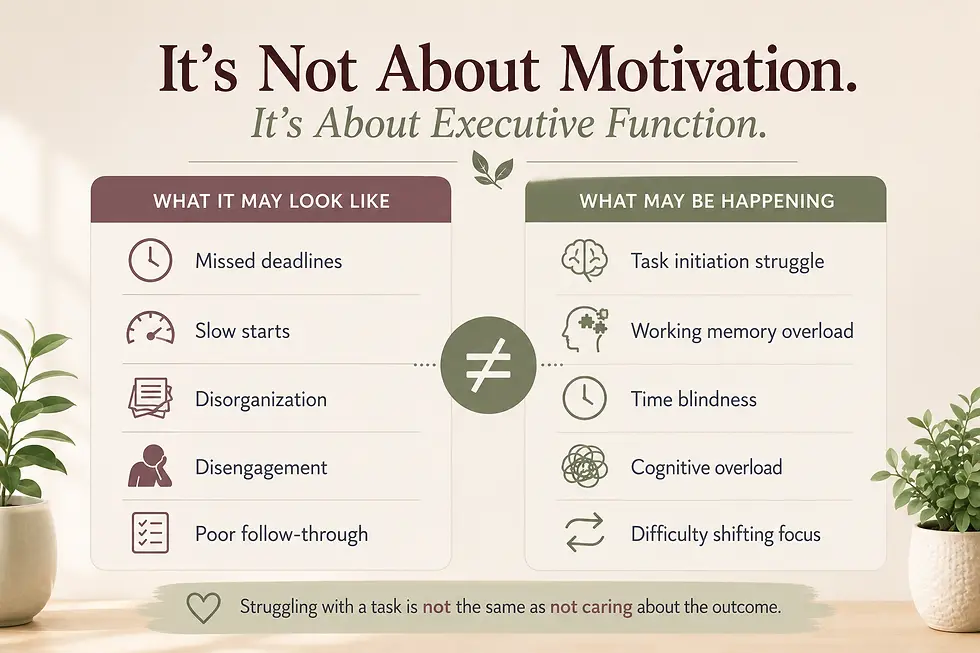
It's one of the most common — and most damaging — misreadings in the workplace. Because in reality, what looks like low motivation is often a brain-based executive function struggle: difficulty initiating tasks, managing time, holding multiple steps in working memory, or shifting focus once it's locked onto something else.
Motivation and executive function are not the same thing. And confusing the two costs both employers and employees more than anyone realizes.
The Employer's View: Why "Just Try Harder" Doesn't Work
Most managers aren't trying to be unfair. They're working with the information in front of them — and on the surface, executive function struggles can look identical to a motivation problem.
An employee who:
Misses deadlines repeatedly, even on tasks they said mattered to them
Starts strong on projects but can't seem to finish them
Seems distracted, forgetful, or disorganized despite clear instructions
Takes a long time to begin tasks, even ones they're capable of doing well
...can easily be read as someone who is disengaged, careless, or simply not trying.
But effort and executive function are different systems. A person can care deeply about their job — even feel anxious and ashamed about falling short — and still struggle to initiate a task, sequence its steps, or manage their time, because those are cognitive skills, not measures of willpower.
Why this matters for employers:
Performance conversations miss the mark. Telling someone to "just be more motivated" or "manage their time better" doesn't give them a tool — it gives them a judgment. If the root issue is executive function, the behavior won't change no matter how many times it's addressed as an attitude problem.
Good employees get lost. Talented, capable people are quietly managed out — or manage themselves out — because their struggles were never correctly diagnosed. The organization loses someone whose actual problem (task initiation, working memory, time estimation) had real, learnable solutions.
Trust erodes in both directions. Employees sense when they're being judged for effort they feel they're genuinely giving. That mismatch breeds resentment, disengagement, and eventually the very checked-out behavior everyone feared in the first place.
The shift for employers isn't to lower standards — it's to change the diagnostic question. Instead of "Why don't they care more?" the more useful question is:
"Where exactly does the process break down for this person, and what kind of support would fix that?"
The Employee's View: Why It Isn't a Character Flaw
If you're the one struggling, the internal experience is often the opposite of "not caring." It's usually:
Wanting to start a task and feeling strangely stuck anyway
Knowing exactly what needs to happen and still not being able to make yourself begin
Losing track of time in ways that feel completely outside your control
Getting deep into a project only to lose momentum or forget key steps
Feeling a wave of shame or self-criticism that makes the next attempt even harder
This isn't laziness. It's a mismatch between what your brain is being asked to do and the executive function skills currently available to do it — skills like task initiation, working memory, time awareness, and cognitive flexibility, which vary from person to person and fluctuate with stress, sleep, and workload.
Why this reframe matters for employees:
It interrupts the shame spiral. Believing "I'm lazy" or "I don't care enough" leads to self-criticism, which increases stress — and stress further depletes executive function. Understanding the real mechanism breaks that cycle.
It opens the door to real strategies. You can't fix a working-memory problem by trying to feel more motivated. But you can fix it with external systems: checklists, body doubling, timers, breaking tasks into smaller steps, or building in structured check-ins.
It changes how you advocate for yourself. Naming the actual block — "I have trouble initiating multi-step tasks" or "I lose time awareness when I'm hyperfocused" — is a very different, and far more solvable, conversation than "I just need to try harder."
The Common Ground
Here's what both sides need to hold onto: struggling with a task is not the same as not caring about the outcome.
Employers who understand this stop mistaking a cognitive block for a character flaw — and start asking better questions that lead to real solutions: clearer task breakdowns, better systems, more predictable structure, and training for managers to recognize what executive function struggles actually look like.
Employees who understand this stop carrying unearned shame — and start identifying the specific supports that let their actual skills and effort come through.
Neither side needs to lower the bar. They need a more accurate map of what's actually happening — because you can't solve a brain-based block with a motivation-based solution, no matter how much effort is on the table
Want to help your managers and teams tell the difference between motivation and executive function — and build systems that support both? Contact Stephanie DeSouza at sd@stephaniedesouza.online to bring executive function training into your workplace.


Comments